
Virtual Fencing
A New Way to Fence the West—Without the Fence
What if you could manage cattle, protect pastures, and keep wildlife moving—without posts, gates, or barbed wire? Sheridan Community Land Trust is testing just that through Sheridan County’s first virtual fencing pilot project. Using GPS-enabled collars, local ranchers are exploring a high-tech, wildlife-friendly way to manage grazing that could save time, cut costs, and improve land and water health.

Financial Outlook: Virtual vs. Physical Fencing
When evaluating virtual fencing, it is helpful to look at it not as a “hardware purchase,” but as a management tool that replaces ongoing labor and infrastructure costs.
Cost Comparison at a Glance
| Feature | Traditional Physical Fence | Virtual Fencing |
|---|---|---|
| Initial Cost | $10,000 to $20,000 per mile | $4,500 to $10,000 per base station |
| Maintenance | High (labor, wire, posts, wildlife damage) | Low (software subscription & hardware warranty) |
| Labor | Manual gathering, fixing breaks, moving wire | Remote monitoring, automated “herding” |
| Flexibility | Static: costly to move or change | Instant: change boundaries in minutes |
| Lifespan | 20-30 years (w/ high maintenance) | Lifetime (hardware replaced via subscription) |
The “Hidden” Benefits (ROI)
Beyond the price of wire vs. collars, producers in the SCLT pilot program are looking for a return on investment (ROI) in these key areas:
- Increased Forage Utilization: By using “strip grazing” or more frequent rotations that would be too labor-intensive with physical fence, producers have seen forage efficiency increases of 15% to 20%. This can allow for a higher carrying capacity on the same acreage.
- Labor Reclamation: Ranchers often report saving 20–40 hours per week during peak grazing seasons by eliminating manual gathers and fence “riding.”
- Precision Health Monitoring: Because the collars track movement and rumination, they can alert you to a sick or lame animal days before you would notice it in a large pasture, potentially saving the animal or reducing vet costs.
- Disaster Resilience: In the event of a wildfire or heavy snow, virtual fences don’t “burn down” or get buried. You can move the herd to safety instantly from your phone.
- Management & Training Support: Through Halter’s Ranch Management Resource Initiative, producers can access leading grazing programs and consulting, with financial support to build the skills needed to get the most out of virtual fencing and strengthen long-term stewardship.
Funding Sources
Virtual fencing projects are supported by a variety of public and private funding sources. SCLT has curated the links below to help producers like you explore potential programs and opportunities that may support virtual fencing on your ranch.
Common Questions About Virtual Fencing
What exactly is virtual fencing?
Virtual fencing is a GPS-based system that allows you to manage cattle movement and grazing boundaries without physical wire or posts. Cattle wear GPS-enabled collars that communicate with an app on your phone or computer. You “draw” your fences on a digital map, and the collars do the rest.
How do the cattle know where the “fence” is?
The system uses associative learning through two types of signals:
- Audio Cue: As an animal approaches the virtual boundary, the collar emits a high-pitched beeping sound.
- Electric Pulse: If the animal continues past the audio warning, it receives a mild electric pulse (similar to a standard electric fence, but often lower in intensity).
- Vibration (Halter specific): Some systems, like Halter, use a vibration cue to signal to the herd that it is time to move to a new, fresh pasture.
How long does it take for cattle to learn the system?
Most cattle learn to associate the audio cue with the boundary within 48 hours to one week. Research shows that once trained, cattle respond to the audio cue alone roughly 90% of the time, rarely requiring the electric pulse.
Do I need cell service for this to work?
No—direct-to-satellite virtual fencing does not require cell service. This newer, cutting-edge approach builds on earlier systems, which rely on towers and cellular networks—and those systems still work well in areas with coverage. The difference is that collars now communicate directly via satellite, allowing them to function reliably in remote areas without service. You can set and adjust boundaries through the app when you have connectivity, and those updates sync to the system. Once in place, fence lines remain active even when you’re offline. That flexibility makes it a strong fit for the kind of country many producers are already working in.
Can I get rid of all my physical fences?
No. Virtual fencing is a powerful tool for internal management (rotational grazing, protecting riparian areas, etc.). However, it is not recommended for perimeter fencing, especially along highways or property lines. It is an “aid” to help you be more efficient, not a total replacement for legal boundary fences. We recommend perimeter fencing be construction to wildlife friendly specifications.
What happens if a cow “breaks” the fence?
If an animal pushes through the virtual boundary, the collar is designed to stop pulsing once they are outside the zone so they don’t get “trapped” out. You will receive a notification on your app showing the animal’s location so you can retrieve it.
What about the batteries?
It depends on the brand. In the SCLT pilot project, the Halter collars are solar-powered, meaning you don’t have to worry about manual battery changes. Other systems may require battery swaps every few months or once a season.
Is there a minimum number of cattle I need to have to use this technology?
- Technically: No. You can put a collar on a single cow if you wish, but many manufacturers have a minimum number to sign up for.
- Economically: Most experts and manufacturers suggest that the “sweet spot” for a return on investment starts around 50 head. This is because the system requires an initial investment in a base station (tower). For very small herds (under 10 head), the cost per animal to install and maintain that tower may be higher than traditional fencing.
- Scale Efficiency: Because the collars are often managed via a subscription, the technology becomes more cost-effective as you scale up. However, for producers managing smaller, high-value herds or those with extremely difficult terrain where any physical fencing is impossible, the technology can still be a “win” even at lower numbers.
- Alternative: SCLT is working on a Virtual Fence Collective to help offset the initial costs of deployment for small producers of less than 50 head. Contact SCLT today for more information.
Is it worth the cost?
- The upfront investment includes collars and base stations (towers). However, producers often see a return through:
- Reduced Labor: Fewer hours spent building, fixing, and checking physical fences.
- Higher Forage Utilization: More precise rotational grazing can increase stocking density or decrease hay costs.
- Ease of Gathering: You can see exactly where every animal is located in real-time on your phone.
How does this help with conservation and wildlife?
- Virtual fencing is the “ultimate wildlife-friendly fence.” It allows elk, deer, and other wildlife to move freely across the landscape without the risk of entanglement or blocked migration routes. It also allows you to instantly “fence off” sensitive areas like creek banks or post-fire regrowth without ever lifting a post driver.
Can I see it in action in Sheridan County?
- Yes! Sheridan Community Land Trust is currently hosting a pilot project with three local ranchers. SCLT plans to host on-ranch field visits in 2026 to show local producers how the technology handles our specific terrain and weather.


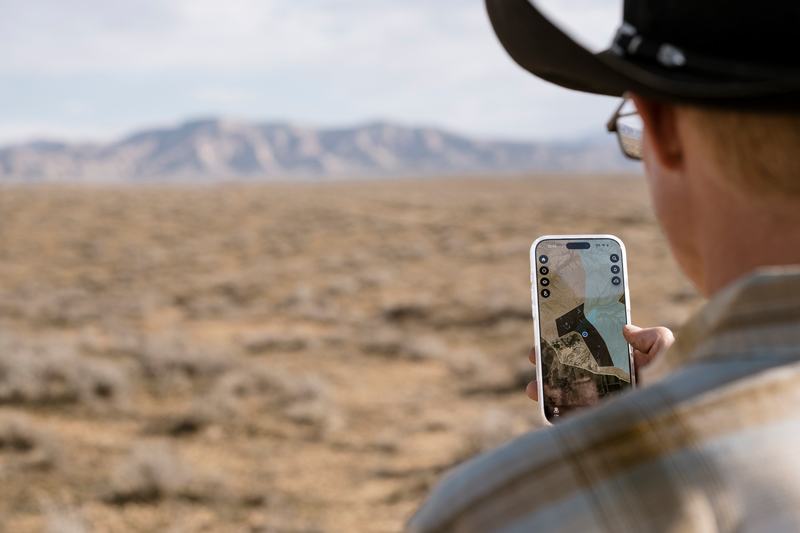
Virtual fencing uses GPS-enabled collars (above) to create “fences” that keep livestock in the grazing areas you choose and out of sensitive places. Unlike traditional fencing, virtual boundaries can be adjusted in minutes from your phone (below), giving you a flexible, efficient way to manage cattle and respond to changing conditions on your ranch.


Attendees gathered at the SCLT Big Goose Natural Area in November 2025 for a field day showcasing how a local rancher is using virtual fencing at BGNA. Stay tuned for more field days in 2026 as we continue to share lessons learned and on-the-ground examples.
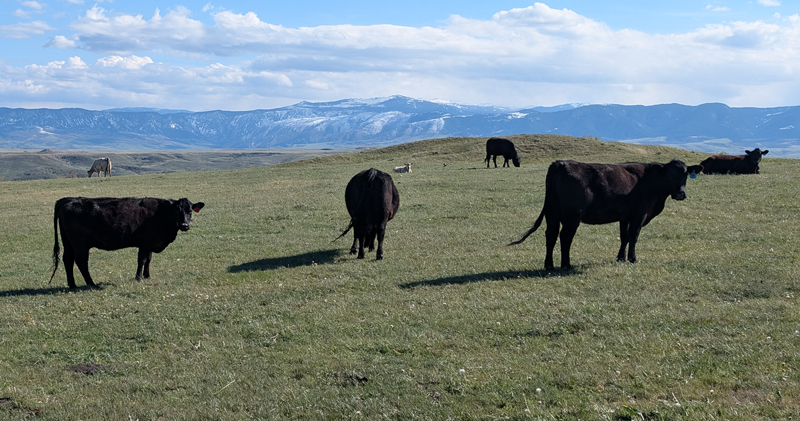
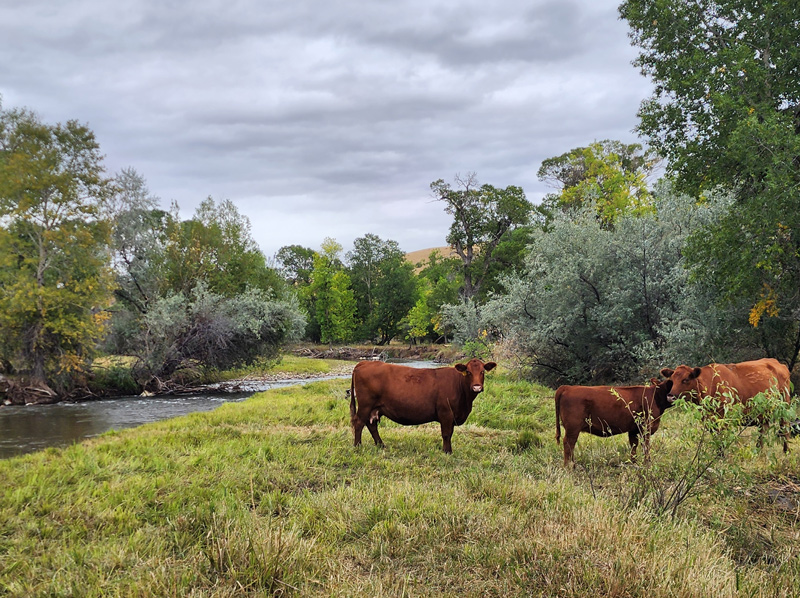
Above: Wide-open pastures like this can be managed without interior fences using virtual fencing. Below: Sensitive areas like streams can be protected by guiding cattle with virtual fencing.
What is Virtual Fencing?
The concept is simple: GPS-enabled collars are placed around the necks of cattle and connect to an app, creating invisible boundaries—limiting the need for posts, gates, and barbed wire. Virtual fencing allows ranchers to view the location of their cattle in an app and provides increased flexibility around where and how to graze their cattle.
“This is the ultimate wildlife-friendly fence—because there’s no physical fence. It helps wildlife move freely, while also saving time and money for ranchers.” ~ SCLT Director of Conservation John Graves
How Does It Work?
Cattle are held within a virtual fence using directional sound cues, followed by a low-emission pulse if the sound cues are ignored. When the rancher decides it’s time to rotate cattle to new pasture, the collar delivers a vibration cue signaling that fresh feed is available, encouraging the herd to move into the new virtual fence. The collars are solar powered, eliminating the need for any battery changes.
A First for Sheridan County
This pilot project is backed by The Nature Conservancy, with support from the World Wildlife Fund, the Natural Resources Conservation Service, and the Sheridan County Conservation District. Three local ranchers are testing the collars on herds of 100-plus cattle each, across a variety of terrain.
Helping Ranchers’ Bottom Line
While it might sound high-tech, virtual fencing is built with ranchers in mind. Beyond labor savings and fewer fence repairs, the ability to precisely manage where and when cattle graze can have a real financial impact.
That said, it’s not yet suitable for every operation. The Halter technology works best where cell service is available and herds are larger, though it can still be used in smaller outfits with different cost structures.
“With an increase in grazing efficiency and vegetation utilization, there is also a decrease in feed costs for ranchers—or they could also see an increase in stocking density. Both of which will help the ranchers’ bottom line.” ~ SCLT Director of Conservation John Graves
Protecting Sensitive Areas
An additional standout benefit of virtual fencing is the ability to create exclusion zones without lifting a post driver.
This is a major win for conservation, giving ranchers more control over grazing while helping to restore and protect streambanks, reduce erosion, and improve water quality.
Conservation Meets Collaboration
SCLT and its partners will monitor rangeland health throughout the project, conducting bi-annual assessments and collecting observations from the ranchers themselves. They’ll be examining plant recovery, soil condition, and wildlife interactions.
See It for Yourself
Sheridan Community Land Trust will host on-ranch field visits in 2026 to give local producers a firsthand look at virtual fencing in action. Details will be announced next year.
This material is based upon work supported by The Nature Conservancy and the U.S. Department of Agriculture, under agreement number [NR246526XXXXC013].


Small Producer Virtual Fence Pilot Program
SCLT’s Virtual Fence Pilot Program is designed to help small producers running 10–50 head test a new tool for managing cattle, improving grazing, and saving time without the high upfront cost. Through a three-year cost-share project, local ranchers can test virtual fencing in real working conditions and decide whether it’s the right fit for their operation.


Questions?
Contact Us Today: