A major barrier to virtual fencing on public lands may be disappearing, and a Bighorn ranching family is helping test what that could mean in practice.
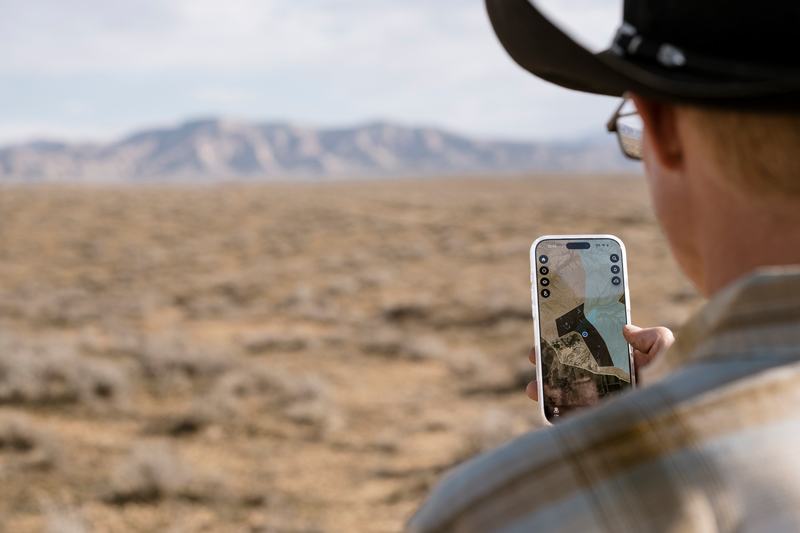
Sheridan Community Land Trust is partnering with the Masters family and Halter to pilot direct-to-satellite virtual fencing on their grazing leases within the Bighorn National Forest. The project will test whether smart cattle collars connected to direct-to-satellite capability can function reliably in rugged terrain on public land, eliminating the need for ground-based communication towers.
Traditional virtual fencing systems require physical towers to relay signals. On federal allotments, those towers often require separate permits and environmental review. The approval process can be complex and time-consuming. In steep and remote landscapes like the Bighorn Mountains, many towers may be necessary to achieve adequate coverage, increasing both cost and logistical difficulty.
Halter’s direct-to-satellite capability removes the need for physical towers altogether. That shift addresses both regulatory barriers related to permitting and physical barriers posed by rugged terrain.
“At its core, this is about practical land management,” said John Graves, SCLT Director of Conservation and Resource Management. “If satellite-based virtual fencing performs reliably without physical infrastructure, it can expand management options across federal, state, and private lands. We are focused on testing how it works on the ground.”
“We’ve always known virtual fencing had the power to improve ranch operations. Connectivity was the blocker for the most remote or large-scale operations, and direct-to-satellite removes that,” said Craig Piggott, CEO and founder of Halter. “We’re excited to see this technology tested on public lands, where infrastructure and permitting requirements have historically limited adoption.”
Halter recently launched direct-to-satellite connectivity in the United States, Australia, and New Zealand. In the U.S., that capability unlocks access for nearly 20 million additional cattle in remote, rugged terrain where cellular coverage is limited or nonexistent. Public land allotments like those on the Bighorn National Forest are often among the most infrastructure-constrained environments.
“Direct-to-satellite virtual fence has the advantage of not needing infrastructure on the ground. Direct-to-satellite virtual fence can be implemented by any producer grazing livestock on public land at their discretion and expense,” said Zach Palm, Bighorn National Forest Rangeland Management Specialist.
The Masters family runs cattle across a mix of federal, state, and private lands, reflecting the structure of many Western ranching operations.
“Terrain plays a big role in our day-to-day management. Cattle tend to congregate around water and riparian areas, which requires careful monitoring to prevent overuse,” Doug and Stephanie Masters explained, saying, direct-to-satellite virtual fence “allows us to better control grazing patterns, protect sensitive areas, and make more efficient use of our pastures while reducing the need for physical infrastructure.”
Conservation partners are also watching closely to see how this approach could benefit wildlife and habitat on working lands.
“Virtual fencing gives us a new way to protect wildlife habitat while keeping working lands productive,” said Linette Sutphin, Pheasants Forever. “Expanding the feasibility of virtual fencing in rugged public‑land landscapes gives us more flexibility to protect sensitive habitat areas and maintain wildlife movement across intact landscapes, while still supporting the function of grazing allotments.”
The implications extend beyond one allotment. There are roughly 24,000 to 25,000 active federal grazing permits and leases nationwide. Grazing is authorized on approximately 155 million acres of BLM land and 93 million acres of National Forest. Federal lands support about 40% of the Western cattle herd and 50% of the nation’s sheep herd during the year.
Infrastructure costs and permitting requirements have been among the most consistent barriers to broader adoption of virtual fencing on public lands. This pilot in the Bighorn Mountains will help determine whether removing those obstacles changes what is possible.
The Masters family will begin using direct-to-satellite virtual fencing this spring.
Learn more about how SCLT helps local ranch families with virtual fencing here