
Fences are as much a part of the West as cattle and cottonwoods. But not all fences are built equal—and some, frankly, get in the way. They can block wildlife, cost ranchers time and money, and still end up wrecked by elk or wind. So what if there were a better way?
That’s the question Sheridan Community Land Trust (SCLT) is asking through a new virtual fencing pilot project using Halter. It’s the first project of its kind in Sheridan County—and it could open new possibilities for ranchers and conservationists alike.
What Is Virtual Fencing?
The concept is simple: GPS-enabled collars are placed around the necks of cattle and connect to an app, creating invisible boundaries—limiting the need for posts, gates, and barbed wire. Virtual fencing allows ranchers to view the location of their cattle in an app and provides increased flexibility around where and how to graze their cattle.
“The ranchers will use the technology to build virtual fences to help manage their cattle and implement rotational grazing strategies,” explained John Graves, SCLT’s Director of Conservation. “That allows for more rest time for those pastures in between grazing cycles.”
“This is the ultimate wildlife-friendly fence—because there’s no physical fence. It helps wildlife move freely, while also saving time and money for ranchers.” ~ John Graves, SCLT Director of Conservation
How Does Halter Work?
Cattle are held within a virtual fence using directional sound cues, followed by a low-emission pulse if the sound cues are ignored. When the rancher decides it’s time to rotate cattle to new pasture, the collar delivers a vibration cue signaling that fresh feed is available, encouraging the herd to move into the new virtual fence. The collars are solar powered, eliminating the need for any battery changes.
A First for Sheridan County
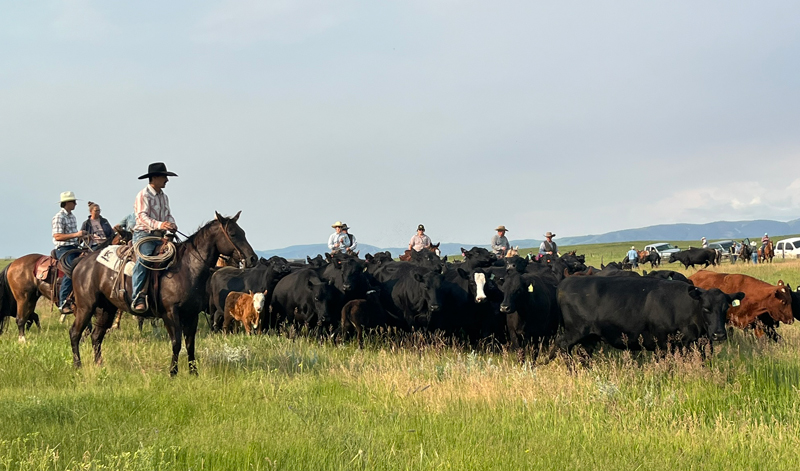
This pilot project is backed by The Nature Conservancy, with support from the World Wildlife Fund, the Natural Resources Conservation Service, and the Sheridan County Conservation District. Three local ranchers are testing the collars on herds of 100-plus cattle each, across a variety of terrain.
The goal? Learn what works, what doesn’t, and how this technology performs on real Western rangeland—not just theory, but application.
Helping Ranchers’ Bottom Line
While it might sound high-tech, virtual fencing is built with ranchers in mind. Beyond labor savings and fewer fence repairs, the ability to precisely manage where and when cattle graze can have a real financial impact.
“Virtual fencing will also allow ranchers to be more efficient and effective in grazing by being able to create as many pastures on their property as they would like. With an increase in grazing efficiency and vegetation utilization, there is also a decrease in feed costs for ranchers—or they could also see an increase in stocking density. Both of which will help the ranchers’ bottom line.” ~ John Graves, SCLT Director of Conservation.
That said, it’s not yet suitable for every operation. The Halter technology works best where cell service is available and herds are larger, though it can still be used in smaller outfits with different cost structures.


Protecting Sensitive Areas
An additional standout benefit of virtual fencing is the ability to create exclusion zones without lifting a post driver.
“This technology will also allow the ranchers to create many exclusion zones, such as along creek banks, riparian areas, or other sensitive habitats,” Graves noted.
This is a major win for conservation, giving ranchers more control over grazing while helping to restore and protect streambanks, reduce erosion, and improve water quality.
Seeing Is Believing
There’s already a buzz in ranching circles—but most producers want proof before they commit.
“Many ranchers know about the technology,” Graves acknowledged, “but they want to see it firsthand and learn from someone local who has used it.”
That’s why the project includes two public ranch field days with the Working Lands Collaborative, in two different years of the three-year project, where producers can observe the tech, ask questions, and get straight answers from fellow ranchers—not sales reps.
Conservation Meets Collaboration
SCLT and its partners will monitor rangeland health throughout the project, conducting bi-annual assessments and collecting observations from the ranchers themselves. They’ll be examining plant recovery, soil condition, and wildlife interactions.
“This isn’t about telling anyone how to ranch. It’s about giving folks more tools to manage their land and livestock in ways that work for them.” ~ John Graves, SCLT Director of Conservation.
See It for Yourself
Sheridan Community Land Trust will host on-ranch field visits in 2026 to give local producers a firsthand look at virtual fencing in action. Details will be announced next year.
- Sign up to receive updates on virtual fencing in Sheridan County.
- Contact our conservation team.
- Learn more about virtual fencing in Sheridan County.
Thank You to Our Partners
The Nature Conservancy, World Wildlife Fund, Natural Resources Conservation Service (NRCS), Sheridan County Conservation District, and three dedicated Sheridan County ranchers who are leading the way for innovation on working lands.