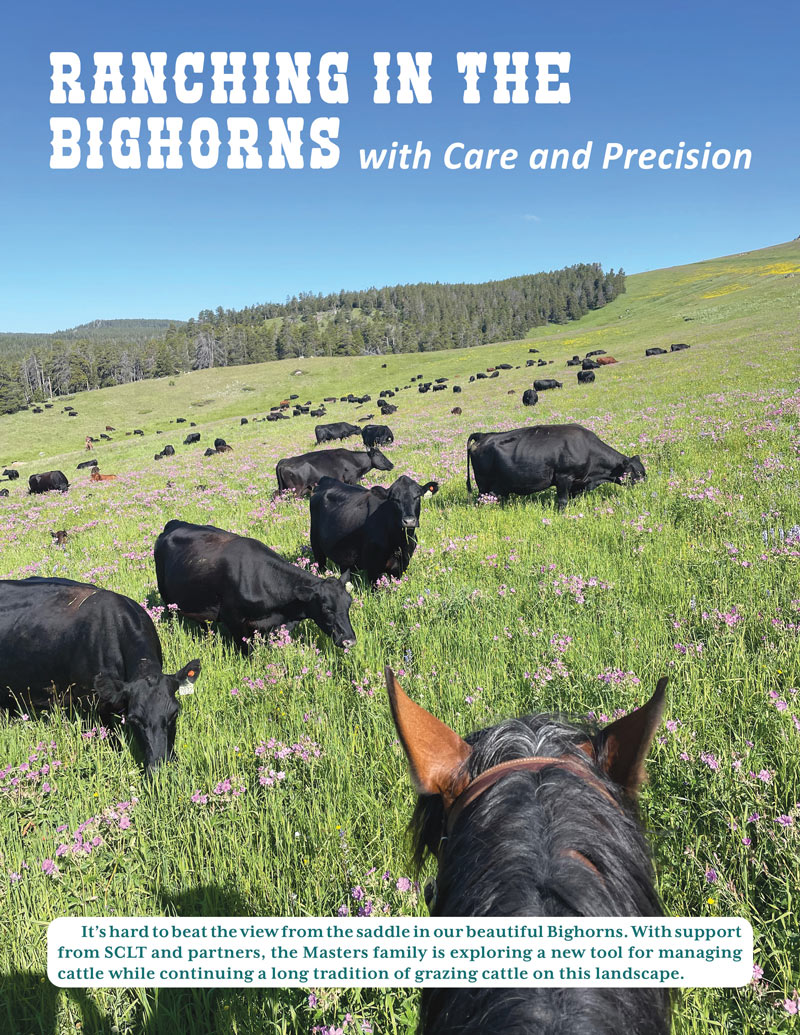
For nearly a century, the Masters family has grazed cattle in the Bighorn Mountains while caring for the land and resources that sustain them. Now, they’re testing whether a new tool can help them do it with greater precision.
A legacy on the land
For the Masters family, ranching in the Bighorns has always been about more than raising cattle. It is about caring for the land, the wildlife that move across it, and a way of life shaped over generations. Now, they are exploring whether direct-to-satellite virtual fencing can help them carry that responsibility forward with greater precision.
The family operates a fourth-generation cattle ranch at the foot of the Bighorn Mountains and has grazed cattle on nearby public allotments for nearly a century. That long history has given them a deep understanding of the landscape and the challenges it presents.
“Ranching here is more than a livelihood. It is a legacy we are proud to carry on for the next generations,” Doug and Stephanie shared.
Working in challenging country
Grazing in the Bighorns presents unique challenges. The terrain is steep and heavily timbered in places. Pastures are large and remote. Maintaining fence in those conditions is time-consuming and often dictated by what is physically possible rather than what is ideal for grazing management.
“Terrain plays a big role in our day-to-day management,” the family explained. “Cattle tend to congregate around water and riparian areas, which requires careful monitoring to prevent overuse.”
These constraints also mean there are areas of the allotment that are difficult to graze effectively. Access limitations, fencing challenges, and the landscape itself can leave some forage underused while other areas receive too much pressure.
A tool to improve precision
Direct-to-satellite virtual fencing offers a potential way to address those challenges. Using GPS-enabled collars and satellite connectivity, the system allows producers to create digital boundaries and manage cattle movement without relying on physical fencing. SCLT is working with its partner, Halter, to implement the system on the ground in the Bighorns.
For the Masters family, the interest is practical.
“We were interested in testing direct-to-satellite virtual fencing because of the opportunity for more effective management of our resources,” they said. “It allows us to better control grazing patterns, protect sensitive areas, and make more efficient use of our pastures while reducing the need for physical infrastructure.”
Managing day to day
The ability to make more frequent, precise adjustments stands out as one of the most promising aspects of the technology.
“We see virtual fencing as a tool that allows us to manage grazing on a much more precise level,” they said. “It allows us to make adjustments daily instead of weekly or monthly and respond more quickly to conditions on the ground.”
SCLT Director of Conservation and Resource Management John Graves said that flexibility is exactly what makes the technology worth exploring.
“In a place like the Bighorns, you are dealing with terrain, wildlife, and weather all at once,” Graves said. “Tools that give producers more control without adding more infrastructure can make a real difference.”
Learning from the land
Beyond day-to-day management, the family is also interested in what the technology could reveal about their cattle and the land itself.
That understanding is tied directly to long-term goals.
“Success for us would mean achieving uniform grazing across our entire operation, improving soil health, and making the most of the land while protecting sensitive areas and resources.”
A shared approach
Graves emphasized that pioneering direct-to-satellite virtual fence in the Bighorns is as much about learning as it is about implementation.
“This is not about replacing traditional ranching,” he said. “It is about working alongside producers to see where this tool fits and where it does not, based on real experience on the ground.”
For the Masters family, that measured approach matters. They see this as an opportunity to test something new without losing sight of what has guided their operation for generations.
“Ranching here is a multi-generational commitment to both our cattle and the land,” they said. “We take pride in managing our pastures responsibly, protecting the ecosystem, and continuing a legacy shaped by nearly a century of grazing in the Bighorns.”
Looking ahead
As their deployment gets underway, the Masters family’s experience will help shape how this technology is understood and applied in one of the most challenging and meaningful working landscapes in the region.
Their work also has the potential to reach far beyond the Bighorns. Across the Mountain West, millions of acres of public lands are grazed each year, often in terrain where building and maintaining fence is difficult, costly, or impractical. Direct-to-satellite virtual fencing could offer a new way to manage those landscapes with greater precision while reducing the need for additional infrastructure.
Graves said that is part of what makes this pioneering project so important.
“What we learn here doesn’t stay here,” he said. “If this works in the Bighorns, it can help open the door for more producers across the West to use this kind of management on public lands.”
For the Masters family, that broader impact ties back to the same values that have guided their operation for generations.
“This isn’t just about raising cattle,” they said. “It’s about stewardship, sustainability, and preserving the land for future generations.”
SCLT thanks Pheasants Forever, The Nature Conservancy, the Property Environment Research Center (PERC), Halter, and Doug and Stephanie Masters for helping make this pilot project possible.
Want to learn more? Visit SheridanCLT.org/Virtual-Fencing.