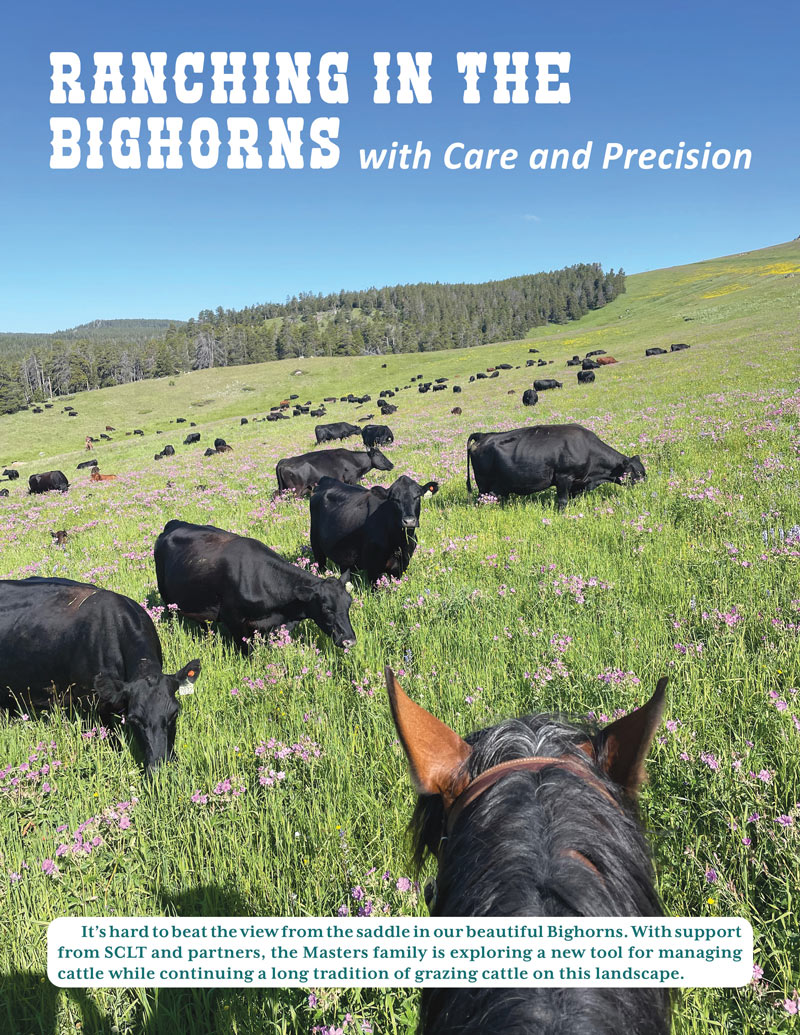

For many ranchers, virtual fencing has sounded promising. Move cattle with a phone. Reduce the need for cross-fencing. Make better use of grass.
But for smaller operations, it has mostly stayed out of reach.
That’s what the Sheridan Community Land Trust is looking to change.
With support from the Plank Stewardship Initiative, SCLT is launching a three-year pilot project designed specifically for small producers running fewer than 50 head, but more than 10 head. The goal is simple. Give local ranchers a chance to test virtual fencing in a way that is practical, affordable, and grounded in real working conditions.
“This isn’t about bringing in something flashy,” said SCLT Director of Conservation and Resource Management John Graves. “It’s about putting a tool in the hands of local producers and seeing if it actually works for them on the ground.”
Through the pilot, SCLT will work with 5 to 10 producers across the Sheridan area, with up to 250 head of cattle collared in total.
Lowering the barrier
One of the biggest hurdles with virtual fencing is cost and scale. Most systems are built for larger operations and require a minimum number of animals to get started.
In this project, SCLT steps in to bridge that gap.
SCLT will hold the master agreement, allowing smaller producers to have access to this tool. SCLT will provide the collars, cover the annual internet fee, and pay half of the annual subscription cost, reducing the standard $90-per-collar cost to $45 per collar per year for three years.
“We’ve heard from a lot of folks who are interested but just can’t make the numbers work at their scale,” Graves said. “This pilot is designed to take that first step with them and reduce some of that risk.”
What it actually changes
At its core, virtual fencing replaces interior cross-fencing with GPS-enabled collars and digital boundaries.
Instead of building fence, producers draw lines on a digital map. Cattle are guided using audio cues and, if needed, a mild correction to keep them within those boundaries.
For producers, that opens up a different way of managing cattle:
- Moving a herd without gathering it on horseback or ATV
- Shifting grazing pressure to underused areas
- Resting pastures more precisely
- Keeping cattle out of riparian areas when needed
“It doesn’t replace good stockmanship,” Graves said. “It just gives you another way to manage cattle, especially when time and labor are tight.”
While SCLT will provide guidance and support, producers remain in control of their operation, using the app to manage cattle movement and make day-to-day decisions.
Built for real ground, not theory
SCLT isn’t coming into this new.
The organization has already helped implement virtual fencing on nearly 1,000 head of cattle locally. This pilot builds on that experience, with a focus on how the technology performs on smaller, often more fragmented pieces of ground.
Each participating producer will receive hands-on support with collaring, setup, and day-to-day use. The goal is not just to test the technology, but to make sure it works in real-world conditions, including rough terrain and varied pasture layouts.
SCLT will work alongside each participating producer during setup, including assisting with collaring cattle and helping get the system up and running on both the animal and the app. Producers will need facilities to safely handle cattle and will take the lead on collaring and day-to-day management, with SCLT providing support along the way.
“We’re not interested in something that only works on paper,” Graves said. “We want to know how it performs in the kind of country our producers are actually working in every day.”
Benefits that matter
For many small producers, time is just as limiting as money. This project is built around that reality.
Virtual fencing has the potential to:
- Reduce time spent building and maintaining fence
- Cut down on daily checks to locate cattle
- Extend the life of existing perimeter fencing
- Improve how evenly cattle use available forage
It also creates new opportunities to protect sensitive areas without permanent infrastructure, including creek bottoms and wildlife habitat.
“That balance between production and stewardship is something our producers already care about,” Graves said. “This just gives them another way to do both at the same time.”
A pilot that works both ways
This is as much a learning project as it is a demonstration.
Producers will help shape how the technology works at smaller scales, providing feedback that can improve how systems are designed and used in the future.
At the same time, SCLT is testing a model that could make virtual fencing more accessible across the region, using a cooperative approach that removes the minimum herd size barrier.
Looking ahead
At the end of three years, the goal is not just a successful pilot, but a clear path forward.
If the project works as intended, it will show that smaller producers can use the same tools as larger operations to save time, improve grazing, and care for the land.
And just as importantly, it will give producers the chance to decide for themselves whether it’s worth adopting long-term.
How to participate
SCLT will select 5 to 10 producers to participate in the pilot through an application process. Not all applicants will be selected, as the goal is to work with a small group of operations to ensure hands-on support and meaningful results.
Selected producers will be notified following review, with collar deployment anticipated in late July through early August. Exact timing will be coordinated directly with participants based on their operation and schedule.
Because this is a working pilot, participating producers should expect to be involved in the initial setup, including assisting with collaring cattle and getting familiar with the system. Ongoing feedback will also be an important part of the project as SCLT works alongside producers to understand what works in real-world conditions.
What to Expect
If selected to participate in the Virtual Fencing Pilot, producers can expect:
- Upfront support from SCLT
SCLT will provide collars, cover the annual internet fee, and pay half of the subscription cost. Staff will work directly with you to get the system set up and running. - Hands-on setup
Producers will take the lead on collaring their cattle and should have working facilities to safely handle livestock. SCLT will assist with collaring and help get both the collars and app set up. - Learning and using a new tool
Producers will use a smartphone app to manage virtual boundaries and move cattle. SCLT will help with setup and provide support, while producers remain responsible for day-to-day use and cattle management. - Time commitment during setup, lighter lift after
The biggest time investment will be during initial setup and collaring. Day-to-day use is designed to save time, but participants should expect to spend time learning and adjusting early on. - Ongoing communication and feedback
This is a working pilot. Participants will be asked to share feedback with SCLT throughout the project to help improve how the technology works for small operations. - Occasional ranch visits (with coordination)
SCLT may coordinate occasional visits with other producers or partners to see the system in use. These will always be scheduled in advance and with your approval.